
.jpeg)


The Beginning
My story began as a young girl growing up on the beautiful island of Barbados, shaped by Caribbean warmth, community, and the understanding that hospitality is about belonging—not exclusivity.
Lola restaurant was originally opened in the 1980s by Eugene Fracchia. After his passing, Tom purchased the restaurant out of bankruptcy around 1990. He had built it into a New York staple before I left corporate America to join him. For more than two decades, Lola was a cultural institution—a beloved innovator melding the rich Southern heritage of rhythm and blues, jazz, gospel, and American cuisine with undeniable soul.
We proudly hosted a loyal, multi-ethnic, international clientele. Music industry insiders,
foodies, celebrities, and anyone up for a rollicking good time found their way to Lola. Tables were shared easily. Neighbors sat beside visitors. Artists mixed with families. Over time, strangers became familiar faces.
If life called for celebration, it happened at Lola.
We earned rave reviews and a two-star rating from The New York Times. Our Sunday gospel brunch became internationally renowned, featured in television specials and films like The Best Man and Brown Sugar. Artists exhibited their work on our walls. Live music filled the air nightly. The space felt alive, warm, open—a true melting pot.
Lola was a formidable business, guaranteed to be a surefire hit no matter the location.
Or so we believed.
The Move to SoHo
In 2007, after many successful years in Chelsea, we made a bold decision: relocate to SoHo to grow the brand and reach new audiences. The move brought fresh energy, new faces, and tremendous possibility.
It also brought fierce opposition. A politically powerful neighborhood alliance—what New York Magazine described as “a litigation-happy activist group that made the American Temperance Society seem like a bunch of pushovers”—decided that Lola did not belong. What should have been a triumphant expansion became a battle for survival.
We fought. We won every legal challenge. But the emotional and financial toll was devastating. The spirit that had sustained us for decades was being systematically
dismantled—not by lack of success, but by organized resistance.
In early 2009, with both our hearts broken, we watched as the doors to Lola were forced to close.
.jpeg)

The Language That Was Used To Shut Lola Down
“We don’t want Harlem here.”
“We are concerned about the kind of people this will attract.”
“We don’t want to turn SoHo into another Harlem.”
“We are protecting the character of the neighborhood.”
“Property values will be affected.”
“This will be difficult to control.”
“This isn’t personal — it’s about standards.”
“You are opening a Black hip-hop club.”
“We are worried about noise, crowds, and late nights.”
“We are acting in the best interest of the community.”
“This does not belong here.”
.jpeg)
These statements appeared in public meetings, legal filings, and community discourse.
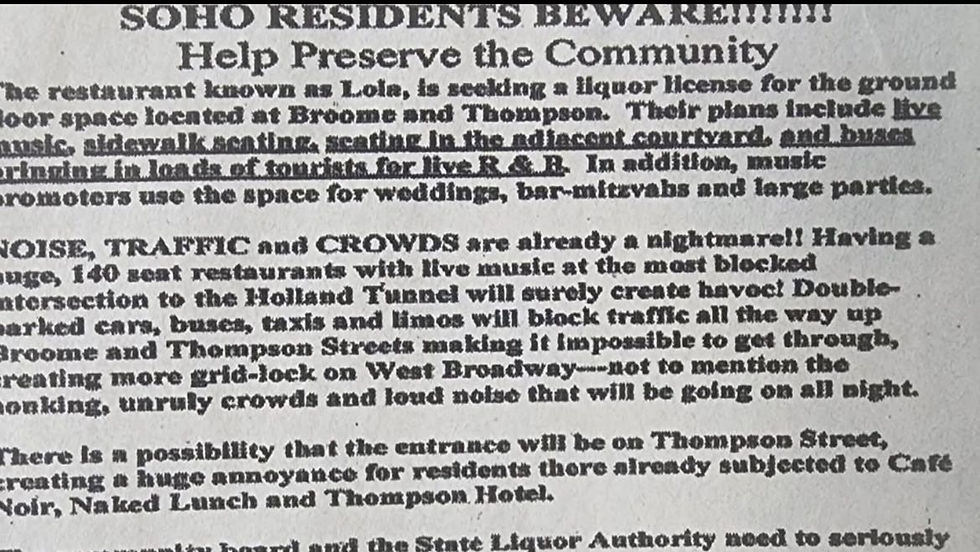
The words did not remain words.
They entered process. They delayed approvals. They justified opposition.
Prejudice rarely announces itself as prejudice.
In Lola’s case, it appeared as objections, delays, hearings, and appeals, each one framed as reasonable, procedural, and neutral.
But the impact was not neutral.

The Aftermath
.jpeg)
.jpeg)
But even in grief, the passion never wavered. The belief in what we had created—and what we could create again—never dimmed.
We learned hard lessons about power, politics, and perseverance.
We learned that love for a community and a vision is not always enough to protect what you build.
But we also learned that resilience is born in the aftermath of loss, and that the work we started was far from finished.
Salon Lola: A New Vision
Now, years later, we stand in our own power—determined to bring a new vision to life.
Salon Lola is the continuation of Lola’s legacy, reimagined for this moment. It is a cultural salon and restaurant hybrid designed not just to serve food and host events, but to create transformative experiences that empower individuals and strengthen communities.
We are building a space where arts, education, food, and politics consciously collide. A place where thought leadership meets artistic expression. A place where civic participation, cultural determination, and political equality are not abstract ideals but lived realities.
Our world is in crisis. Constructs that create division and inequality persist. But our world is also ready for bold ideas, calling for leaders who step forward with solutions rooted in
authenticity, compassion, and collective action.
Salon Lola answers that call.
We can live our lives one of two ways: either out of circumstances, or out of vision.
We choose vision.
This is Lola’s long way home.


